


Six use cases enabled by Symphony for Medical Coding SNOMED CT
Six things you can build on SNOMED CT
SNOMED CT is usually described by its size: more than 350,000 concepts. The structure underneath matters more. Concepts sit in a hierarchy, carry defined relationships, and can be combined, which lets software work with clinical data by meaning.
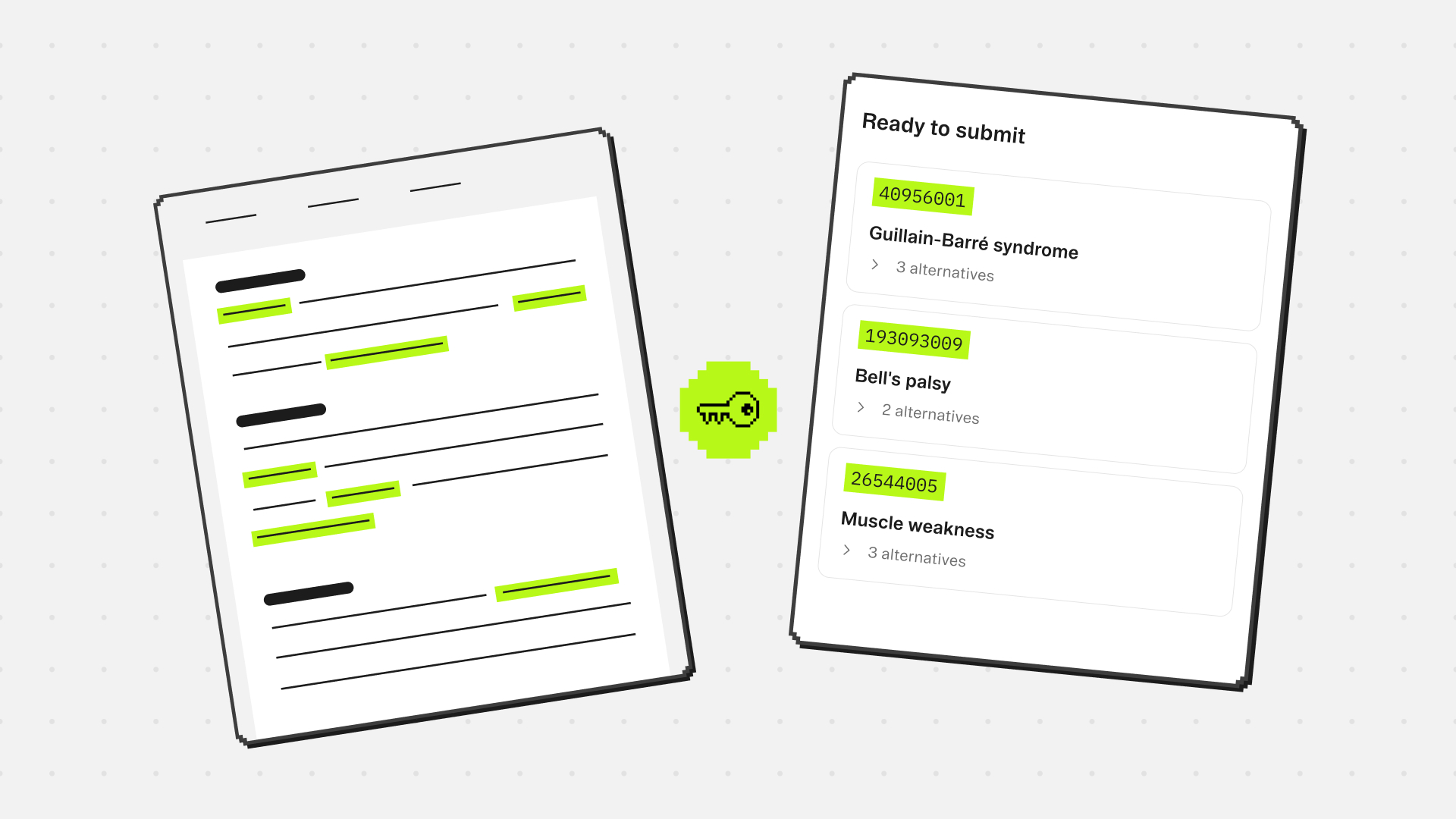
For years, the hard part was getting notes into SNOMED CT in the first place. Now that Symphony for Medical Coding supports SNOMED CT, developers can turn clinical narrative into SNOMED CT concepts with one API call. Here are six things that makes possible.
Capture once at the point of care
The same encounter is often coded several times: once for billing, once for the problem list, and again for registries and reporting. Each pass adds cost, delay, and room for inconsistency.
SNOMED CT ships with official maps to ICD-10, so a single structured record created at the point of care can feed every downstream use. Coding moves from a back-office task after discharge to something that happens as care is documented.
For builders: one coding pass replaces separate pipelines for billing, clinical records, and reporting, and every product feature reads from the same data.
Example applications:
- Ambient scribes that return a coded record alongside the note
- Automated problem list maintenance in EHRs
- Revenue cycle and coding assistance tools
- Registry and quality reporting pipelines
Cohort queries that work by meaning
Defining a patient population is the foundation of clinical research, quality measurement, and population health. With billing classifications, that definition is a hand-built code list that each team maintains separately and rebuilds after every classification update. Definitions drift between teams, and results become hard to compare.
SNOMED CT's hierarchy lets a query target one parent concept and automatically include everything beneath it. Cohort definitions become consistent, reusable, and current by default.
For builders: research, recruitment, and analytics products can offer cohort definitions that stay accurate without ongoing list maintenance.
Example applications:
- Clinical trial matching and recruitment platforms
- Real-world evidence and research analytics
- Quality measure reporting
- Population health dashboards
Decision support that fires on concepts
Clinical decision support is only as reliable as the data it reads. Rules built on billing codes tend to grow long, carry reimbursement logic unrelated to the clinical question, and fail quietly when code sets change.
Rules written against SNOMED CT concepts cover an entire branch of the hierarchy at once. They stay short, readable, and stable as the terminology evolves.
For builders: lower maintenance cost for alerting and guidance features, and fewer silent failures after code set updates.
Example applications:
- Point-of-care alerts and guidance in EHRs
- Care gap detection
- Prior authorization and medical necessity checks
- Clinical guideline agents
Interoperability across borders
Healthcare data increasingly needs to move between systems, organizations, and countries. FHIR uses SNOMED CT as its preferred code system for conditions, procedures, and observations, and the European Health Data Space depends on shared terminology to make cross-border exchange work.
National extensions handle local requirements, while the international core keeps the meaning of each concept stable everywhere it is used.
For builders: one data model that works across markets. Symphony supports the International edition and seven national editions through the same endpoint, so entering a new country does not require rebuilding the data layer.
Example applications:
- FHIR-based integration and data exchange
- Cross-border patient summaries
- Health information exchanges
- Multi-country clinical data platforms
Surveillance of what has no code yet
New conditions, exposures, and patterns of harm appear faster than classification systems are revised. Until a new code is released, an emerging trend is hard to count, which slows the public health response.
SNOMED CT concepts can be combined to express something no single concept describes. Emerging patterns become visible as soon as clinicians begin documenting them.
For builders: public health, safety, and surveillance products can track new signals without waiting for the next classification update.
Example applications:
- Public health reporting tools
- Pharmacovigilance and adverse event monitoring
- Patient safety and infection monitoring
- Syndromic surveillance dashboards
Capturing what classifications leave out
Billing classifications keep what billing needs. Much of what matters clinically falls outside that, including functional status, nursing observations, social circumstances, and findings that never carry a reimbursement code.
SNOMED CT has room for all of it, along with the ability to represent negation, family history, and timing. The result is a fuller record of the patient that goes beyond the reimbursable summary.
For builders: care management, risk stratification, and clinical search products get the detail they need to be useful.
Example applications:
- Care management and coordination platforms
- Risk stratification and risk adjustment
- Social needs screening and referral
- Clinical search across patient records
From terminology roadmap to product feature
SNOMED CT has supported these applications for years. Adoption lagged because populating it by hand never scaled.
Automated coding changes that. Send a clinical note to Symphony for Medical Coding and get SNOMED CT concepts back, with the supporting evidence for each one. Try the interactive SNOMED CT demo, read the documentation or get an API key to start building.
More guides to explore
Build faster. Ship safer. Scale smarter.
Get started with healthcare-native APIs built to power real clinical workflows.