TL;DR
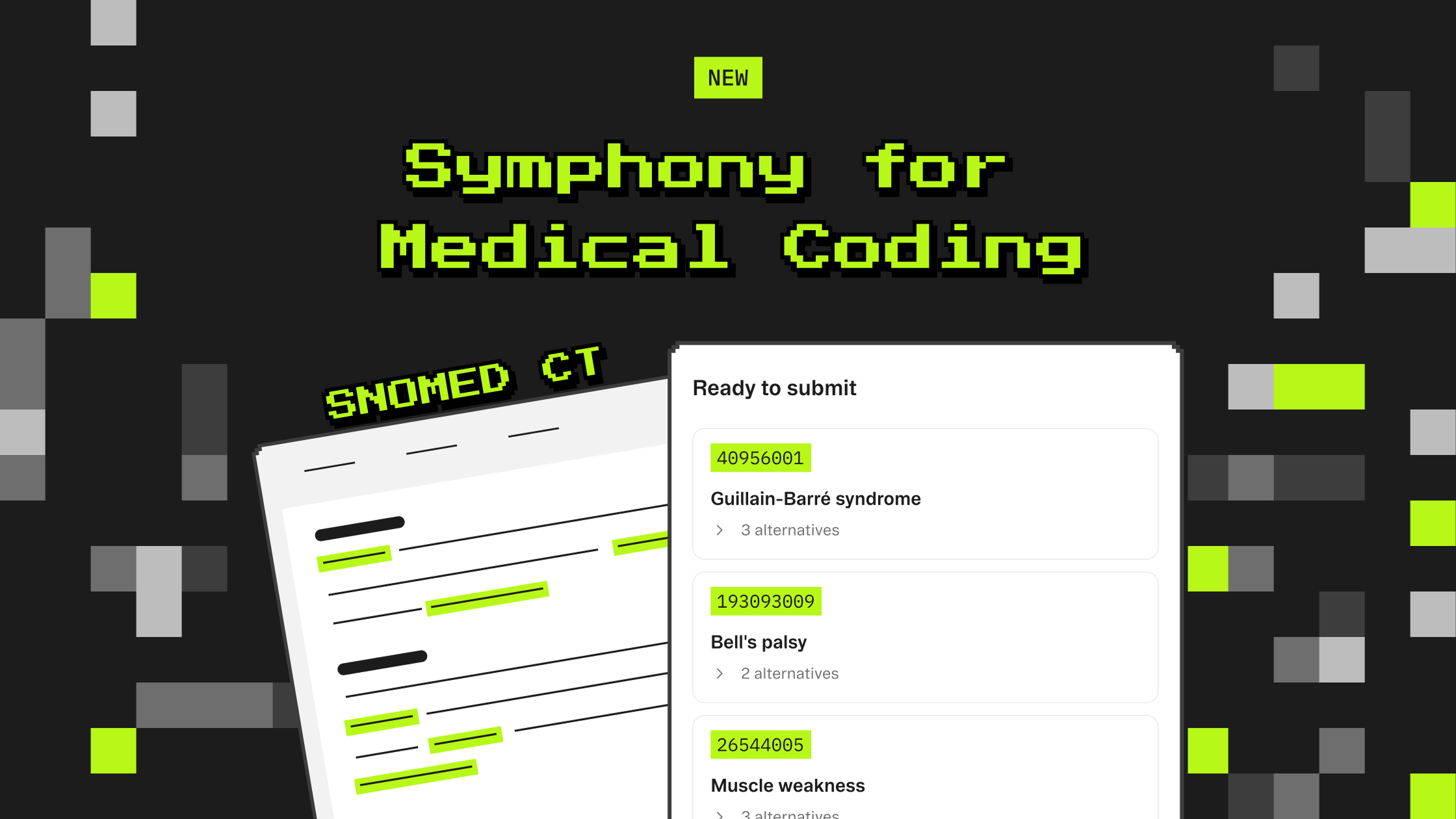
- Symphony for Medical Coding now supports SNOMED CT, available in beta through the Corti API.
- Symphony performs entity linking natively, reading a clinical note and mapping each relevant finding, disorder, and procedure to a SNOMED CT concept, with the supporting text from the note and ranked alternatives.
- SNOMED CT is available in the International edition and in national editions for France, Germany, Spain, the UK, the US, Denmark, and Sweden.
When we launched Symphony for Medical Coding, we started with ICD-10 and CPT, the systems that drive billing and reimbursement. We also said SNOMED CT would follow. Starting today, Symphony for Medical Coding supports SNOMED CT.
If your product needs SNOMED CT for an EHR integration, a national health data requirement, clinical decision support, or research cohorts, you no longer have to build and maintain the terminology layer yourself. Send a clinical note to the API and get SNOMED CT concepts back.
Why SNOMED CT
ICD-10 has around 14,000 codes and was built mainly for classification and billing. It does that job well, but it runs into limits when the goal is capturing clinical detail. SNOMED CT has over 350,000 concepts covering symptoms, findings, procedures, body structures, and devices. Those concepts can also be combined to express things no single code was built to describe. SNOMED CT is used in over 40 countries for electronic health records and clinical documentation.
Coding a note in SNOMED CT turns it into a complete, structured record that software can work with directly. For builders, that matters in a few ways:
- Build once, reuse everywhere. Problem lists, alerts, search, analytics, and summaries can all read the same concept IDs. Each new feature skips the work of parsing free text again.
- Logic that works by meaning. Because of the hierarchy, a feature written against "diabetes mellitus" covers every subtype. You don't build or maintain code lists, and features keep working as the terminology grows.
- Capture once, derive the rest. SNOMED CT has official maps to ICD-10. One coding pass can feed billing, registries, and quality reporting, so you don't run separate pipelines for each.
- Market access. FHIR prefers SNOMED CT for conditions, procedures, and observations. National systems like the NHS in England require it, and the European Health Data Space builds on it. Native support lets you sell into those markets without rebuilding your data layer.
- More of the clinical picture. ICD-10 keeps what billing needs. SNOMED CT also captures findings, symptoms, functional status, and social context. Products like care management, risk stratification, and clinical search depend on that detail.
- A stable vocabulary for AI agents. Downstream agents can reason over verified concept IDs instead of raw text, which makes their outputs checkable and easier to trust.
That level of detail is what makes cohort queries, decision support, and cross-border interoperability possible. For a longer look at what SNOMED CT can express and why it matters for AI, read SNOMED CT: healthcare's new common language (and why AI should care).
Six things SNOMED CT makes possible
- Capture once at the point of care: one documented concept feeds the billing code, the problem list, and registry submissions.
- Cohort queries by meaning: query a parent concept like diabetes mellitus and every subtype comes back automatically.
- Decision support on concepts: rules stay short and keep working as new concepts are added.
- Interoperability across borders: a concept ID means the same thing in Stockholm and in Seattle, and FHIR uses SNOMED CT as its preferred code system.
- Surveillance of things with no code yet: combine concepts to track an emerging condition the week clinicians start seeing it.
- Capturing what classifications discard: functional status, social circumstances, family history, and other detail billing codes leave out.
Read six things you can build on SNOMED CT for the full detail on each.
Entity linking is the hard part
Supporting SNOMED CT is mostly an entity linking problem. Entity linking means finding a clinical mention in free text and connecting it to the correct concept in the terminology. Clinicians describe the same condition in many ways ("MI," "heart attack," "myocardial infarction"), and the same words can point to different concepts depending on context. With hundreds of thousands of concepts to choose from, string matching returns long lists of loosely related candidates that someone still has to review.
Getting this step right matters because everything downstream depends on it. A concept ID is only useful if it is the correct one. When linking is wrong, cohort queries return the wrong patients, decision support triggers on the wrong conditions, and mappings to ICD-10 or other systems carry the error forward.
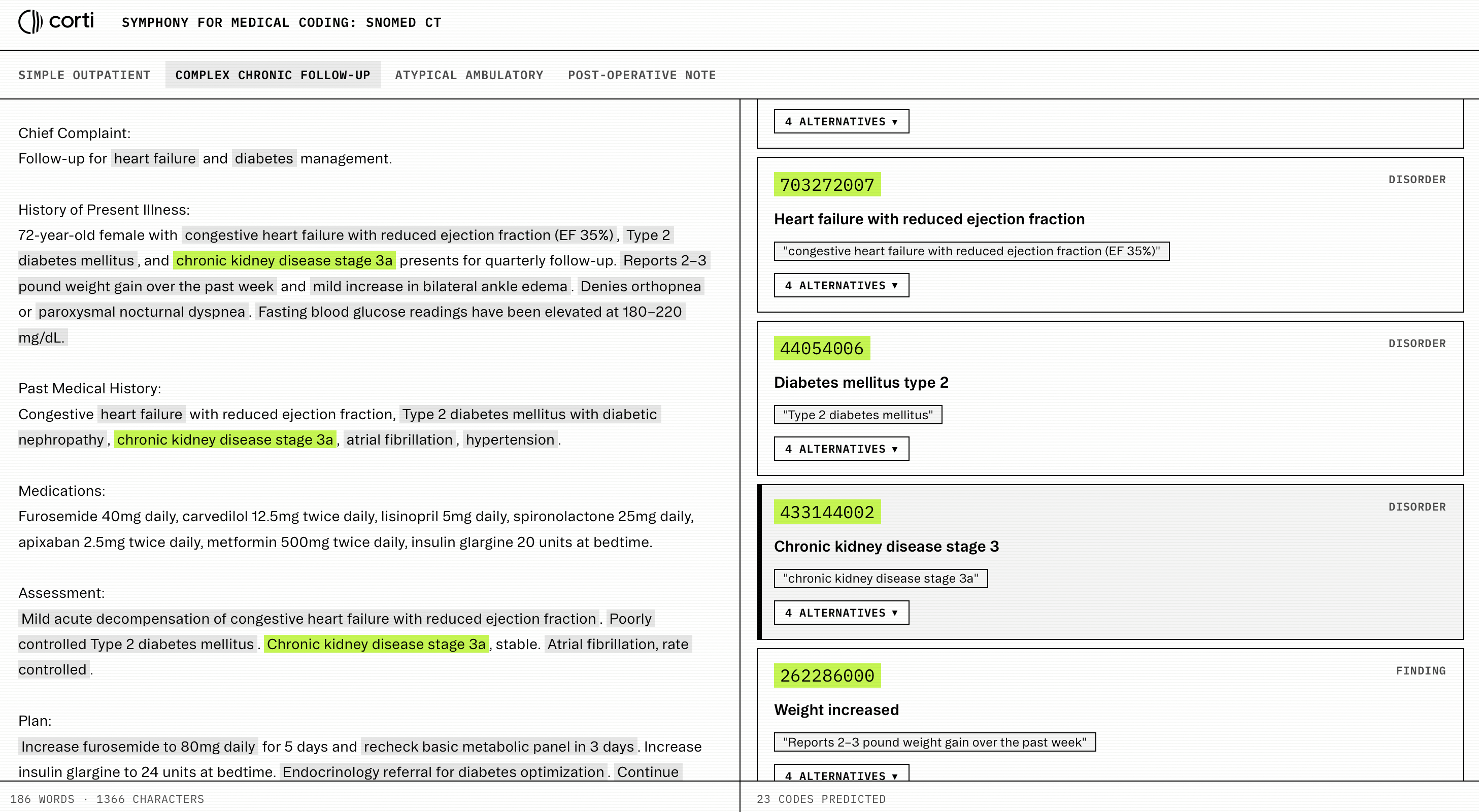
Symphony applies the same reasoning approach it uses for ICD-10. It first identifies what in the note should be coded, then resolves each mention to a specific SNOMED CT concept. Every prediction includes the exact text span that supports it and ranked alternative concepts, so your application or a reviewer can see why a concept was chosen.
How it works in the API
SNOMED CT uses the same request and response structure as the other coding systems in Symphony for Medical Coding. Send a clinical note, select SNOMED CT and an edition, and the API returns:
- Predicted concepts for findings, disorders, and procedures
- Evidence spans from the source note for each prediction
- Alternative concept suggestions
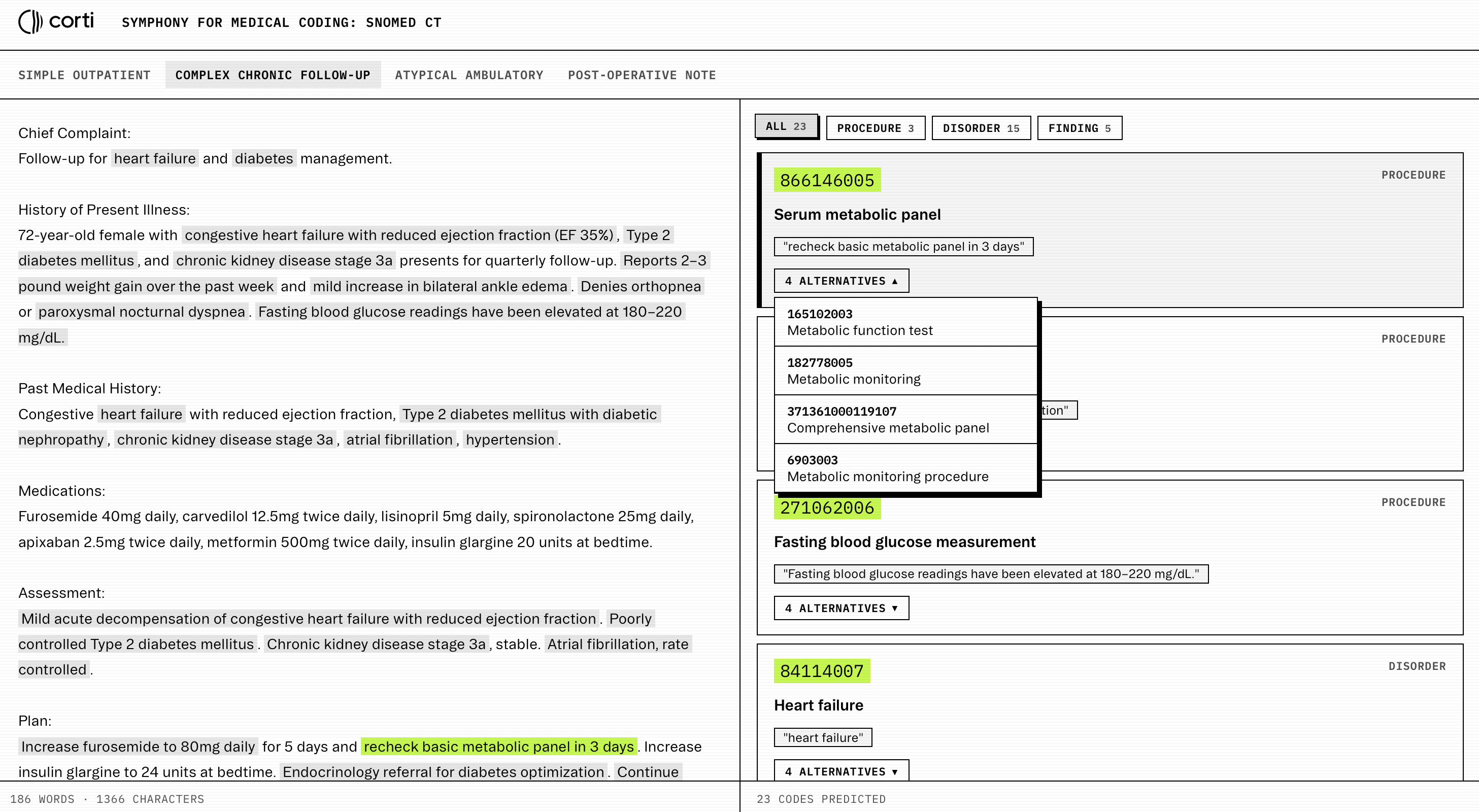
You can also filter predictions by semantic tag, the clinical category a concept belongs to. For example, to return only disorders and findings:
"filter": {
  "include": [
    { "property": "semantic_tag", "op": "in", "value": ["disorder", "finding"] }
  ]
}
Supported values are disorder, finding, procedure, and regime/therapy. See the SNOMED CT documentation for the full reference and code filtering for other filter options.
Ready to build on today
SNOMED CT is live in the Corti API today in beta. You get concept predictions, evidence spans, and ranked alternatives across the International edition and seven national editions, through the same endpoint you already use for ICD-10 and CPT. There is no terminology server to stand up, no mapping tables to maintain, and no model to train.
Symphony reasons directly over the terminology, so every improvement reaches you through the API with no retraining or migration on your side. The International edition reaches 54.8% micro F1 on the SNOMED CT Entity Linking Challenge, and we are now validating on real clinical notes and on each national edition. Teams building now shape what comes next: run it on your own notes and tell us what you see.
Want to see it first? Try the interactive SNOMED CT demo, with sample notes ranging from a simple outpatient visit to a complex chronic follow-up.
Get started
SNOMED CT is available now through the Corti API and Console. Get an API key, read the documentation, or talk to our team.
Build faster. Ship safer. Scale smarter.
Get started with healthcare-native APIs built to power real clinical workflows.