Criticism of AI in healthcare documentation is stacking up fast, focusing on recurring errors like incorrect drug names, tedious editing time, and lack of nuance. A recent Healthcare Dive article even labeled AI scribes a malpractice risk, citing an Annals of Internal Medicine study that scored 11 commercial AI scribes below 18 human clinicians across all 10 quality dimensions.
But it wasn't tested under real conditions. Documentation quality degrades for humans under pressure: packed waiting rooms, frequent interruptions, and late shifts, conditions that don't touch AI the same way, since its edge is that it doesn't get tired. AI notes aren't perfect, but the real questions are what baseline we compare them against, who bears the risk of getting them right, and what the ultimate solution looks like.
The clinician holds the liability. Is that fair?
When an AI tool gets something wrong, who's responsible? Medicine already had a default answer to that question, the same one law and engineering have used for decades. You blame the mechanic, not the wrench. The answer, a human in the loop. The clinician reviews what the AI produces, then signs off on it, and the responsibility sits exactly where it always has. It's easy to see why that unsettles people. When clinicians hold the liability for a black box tool they didn't build and can't audit, their panic isn't paranoia. It's a fair reading of the risk.
The flaw in human-in-the loop
Human-in-the loop assumes vigilance scales. It doesn't. AI documentation tools exist to solve one problem: the fatigue of writing or typing after spending hours treating patients. But asking the clinician to review everything the AI produces just swaps documentation fatigue for validation fatigue. It's a different task but not a lighter one.
Once the volume of text a person is asked to check gets large enough, review stops being a genuine check and becomes a heuristic, scanning for what looks wrong and trusting the rest. Both kinds of fatigue carry the same risk. A tired clinician missing something while writing a note by hand, and a tired clinician missing something while reviewing a note they didn't write, land in the same place, an error that reaches the patient.
Shifting risk back to the clinician
The usual answer to this is training. Upskill the clinicians, teach them how to review AI output properly, build it into onboarding. But notice what it does: it takes the burden that just moved from documentation to validation and asks the clinician to carry it better, rather than asking whether the tool should be creating that burden at all. Every fix so far, human-in-the-loop, then training to make humans in the loop work, has landed back on the same person. The one already responsible for the patient.
Beyond that risk lies cognitive erosion. When clinicians approve AI suggestions instead of forming their own diagnoses, independent diagnostic skills erode. Cognitive science distinguishes between fast, heuristic thinking and slow, critical analysis; an always-on tool pulls clinicians toward fast thinking by default. That is a design problem.
The fix isn't asking the clinician to try harder. It's building friction into the right places on purpose: a system that asks for the clinician's own read before it offers its own, that has to be actively sought out rather than sitting there pre-empting the thought. The responsibility for getting this right sits with whoever designs the system, not with the person using it under pressure.
Corti has been building AI scribe technology for a long time. Every generation of tooling has a first version that gets the shape right and the execution wrong, and the AI scribe is no exception. Call that first generation the summarizer: record the visit, hand the transcript to a model, hope. It's what the Annals study measured, and what Healthwatch, Dartmouth, and the rest of the criticism are describing. It's failing the way first generations tend to fail. What's changing now is the species itself.
Because look at what human-in-the-loop actually does to the person carrying it: it takes the shortcomings of a technology that's still evolving and puts the burden of catching them back on the human. Healthcare workers are here to treat patients, not constantly adapt to new software interfaces that add friction where there should be none.
Designing the next species
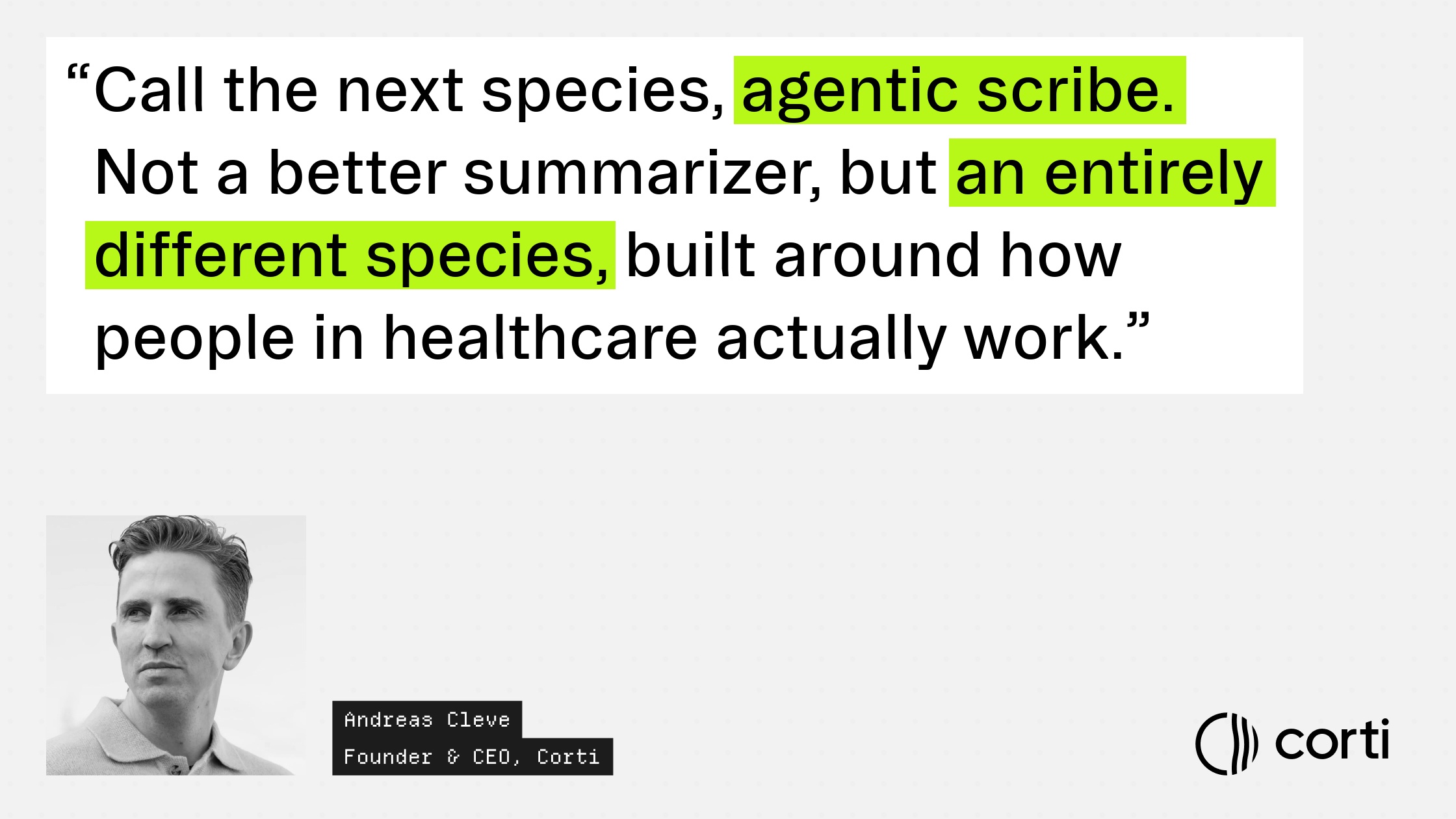
Call the next species, agentic scribe. Not a better summarizer, but entirely a different species, built around how people in healthcare actually work instead of asking them to work around it, and built to stop the degradation human-in-the-loop quietly demands. It's designed to solve exactly the problem raised earlier, that vigilance doesn't scale, and skill erodes when a tool hands over finished work unchecked.
Here's what that looks like across a single visit.
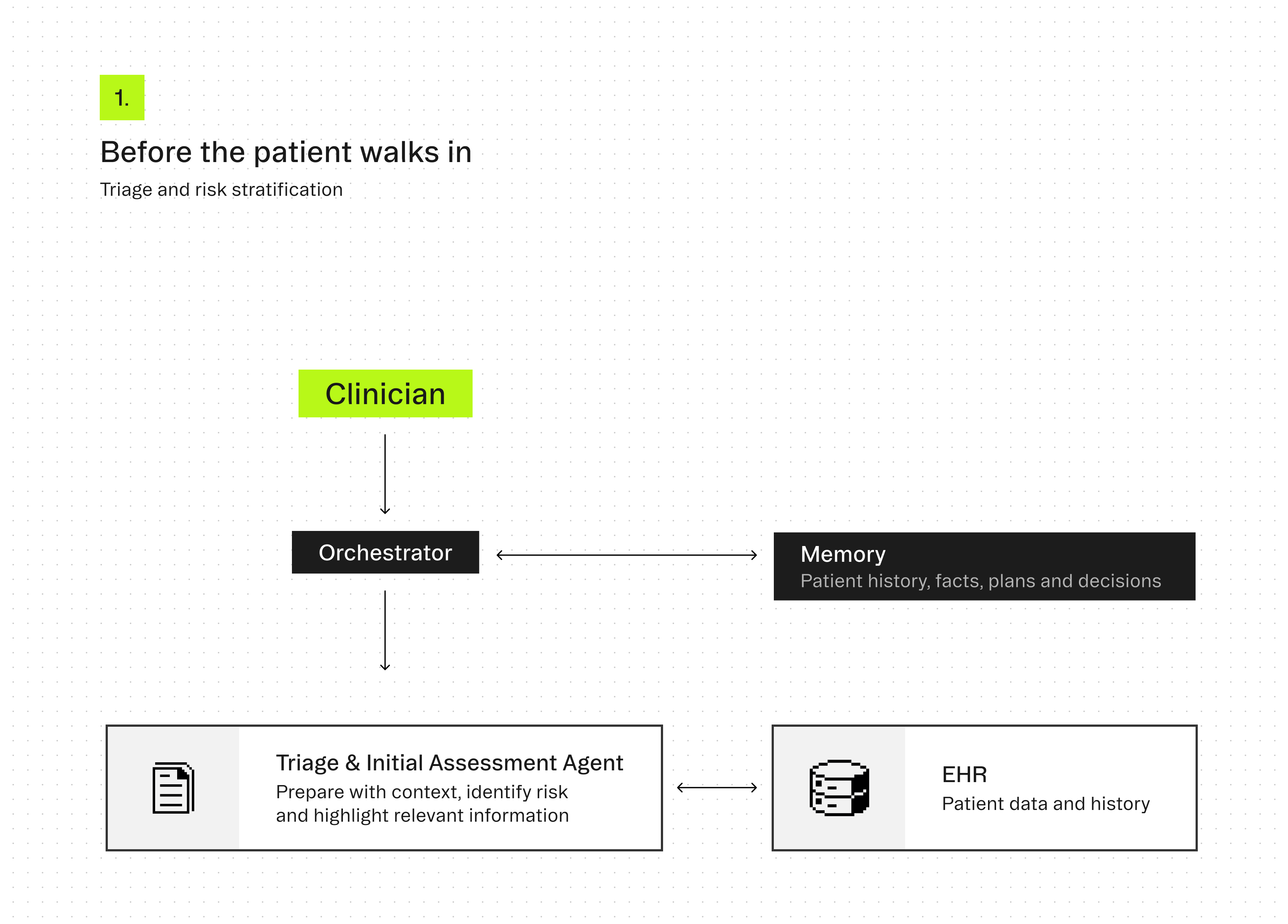
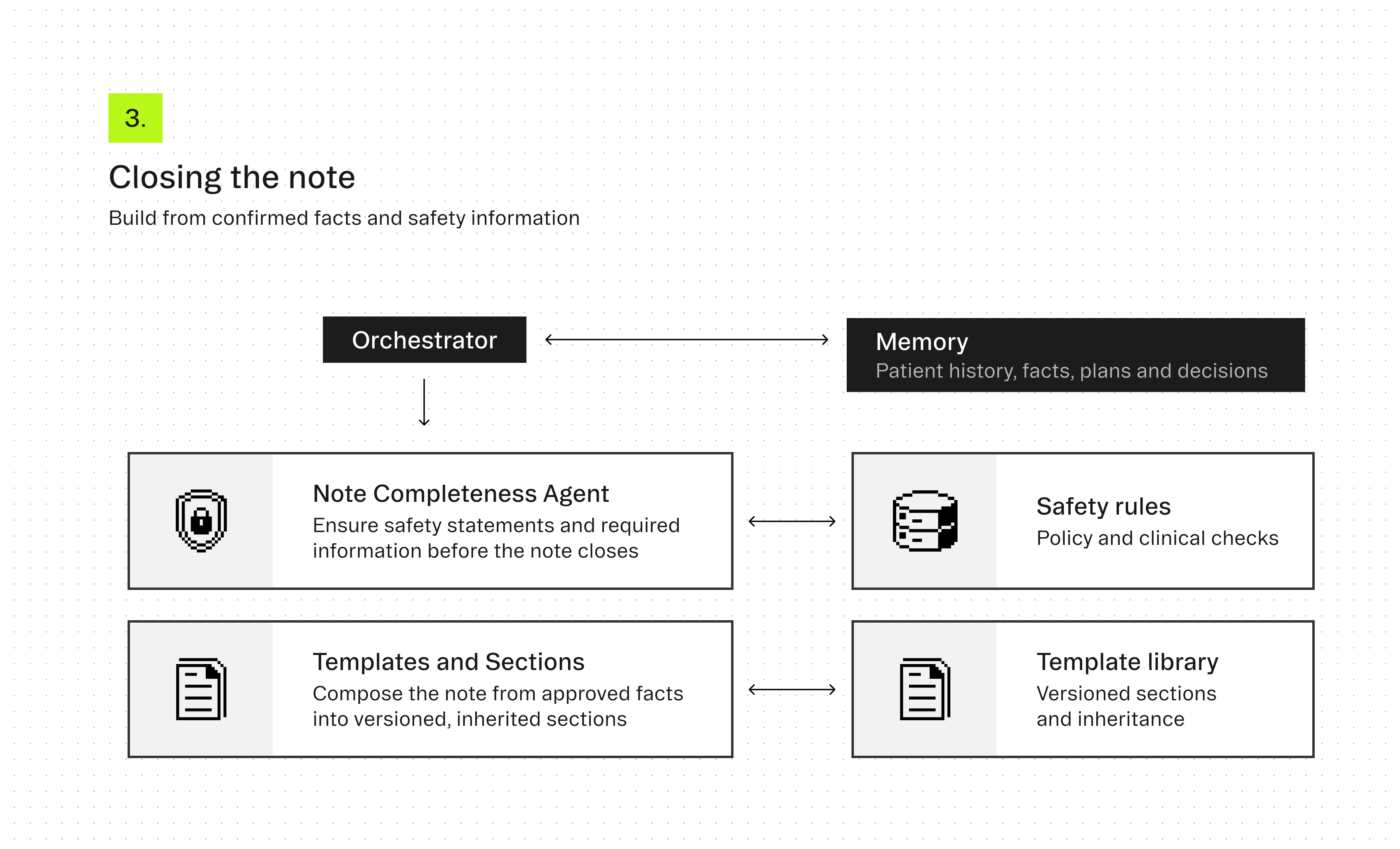
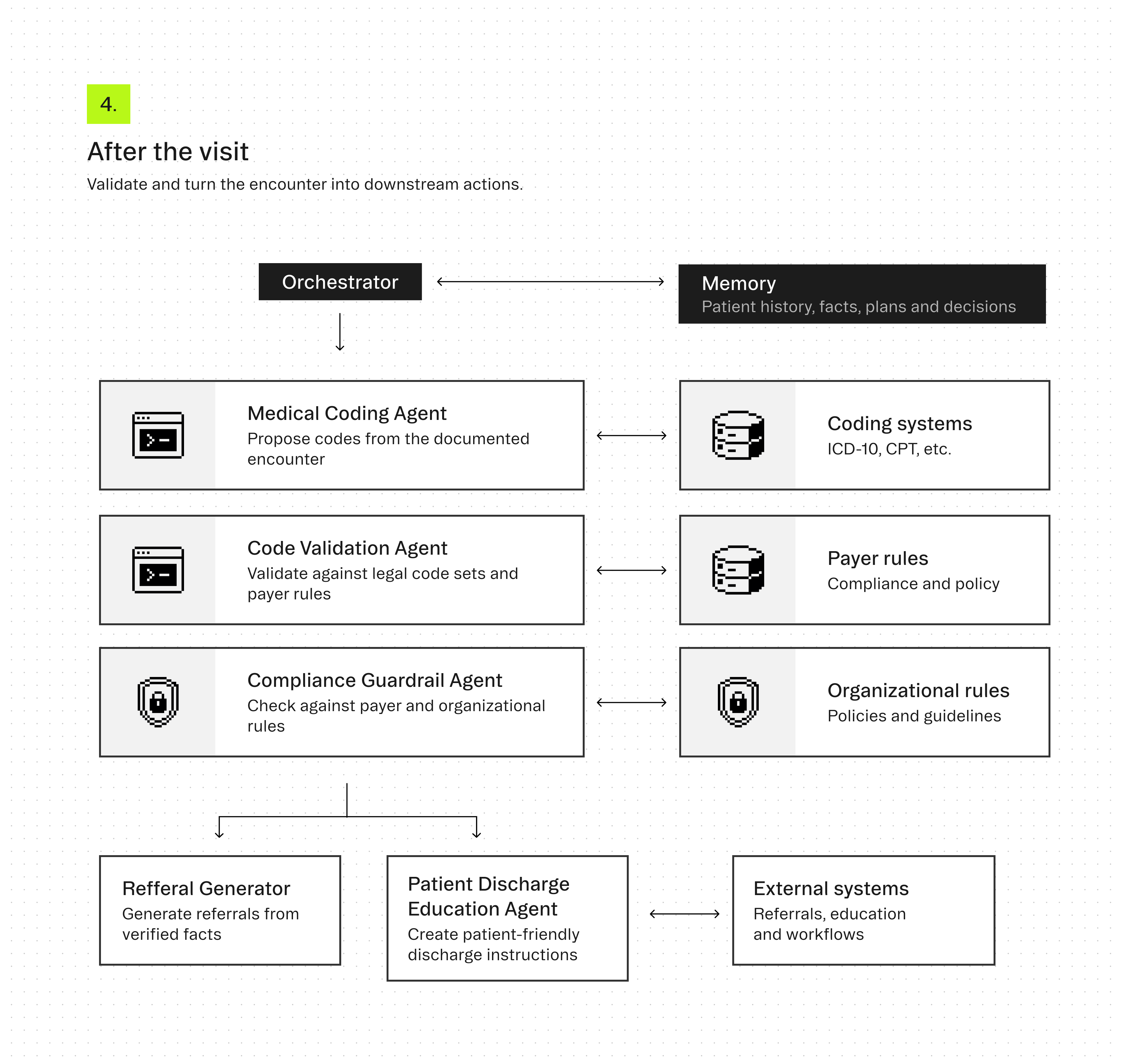
Before the patient sits down, risk is already being triaged by an agent. In the room, facts get confirmed as they're said instead of guessed later, and the plan is checked against clinical guidelines while it's still being formed. Closing the note, safety statements can't be skipped or buried, and the note itself is built from confirmed facts rather than one long pass at writing it. After the visit, coding, validation, and compliance run before anything reaches billing, and referrals and discharge instructions come from the same facts the clinician already confirmed, not a fresh summary written from scratch.
None of this is one model doing everything. It's the chain, agent by agent, shown below.
.png)
That's the shift Corti is building toward, an agentic AI scribe framework built around how people in healthcare actually work, not around what a model can produce. The Annals authors call for vendor-neutral evaluation before large-scale deployment. Correct. Eleven summarizers just scored below humans. Now benchmark the next species.
Build faster. Ship safer. Scale smarter.
Get started with healthcare-native APIs built to power real clinical workflows.