Yesterday I sat down with one of Europe's most important system integrators, the people who wire AI into some of the continent's most critical white-collar industries.
Their Chief AI Officer said something that would horrify half my LinkedIn feed: Up until now, we haven't seen any important companies ask for sovereign AI to replace American labs.
He's right.
I co-lead a company betting on European AI infrastructure, so let me explain why I agree.
Nobody buys flags. Value in AI accrues overwhelmingly at the frontier, and until recently, asking for "sovereign AI" in Europe usually meant asking for worse AI (sorry, Mistral, I'm rooting for you). Serious companies don't order worse on purpose. They order it when they can get away with it to get the job done, and the most important tasks still need frontier intelligence.
So European buyers did the rational thing: they bought American frontier intelligence and kept quiet about the geopolitics. The absence of demand for the sovereign label was never the absence of the problem. It was evidence that capability beats ideology in almost every procurement meeting.
To see where this goes next you need the right mental model, and one of the best things I've read on the AI market lately comes from the excellent Giovanni Cattani.
Everyone models AI supply, and the supply is spectacular: roughly $1 trillion of AI investment in 2026, equal to France's GDP, with estimates heading higher. But as Cattani says, almost nobody models demand.
He builds a taxonomy of AI work on two axes:
How big is the task? Every model can complete work up to a certain size, and according to some, the horizon has roughly doubled every seven months for six years and will keep going.
And does the work ever end? Bounded tasks are finite: taxes, a discharge note, a compliance check. There's a "done." Unbounded tasks have no obvious ceiling, and the more intelligence you throw at them, the more value you accrue: research, trading, building software, improving strategy. More intelligence keeps being worth more.
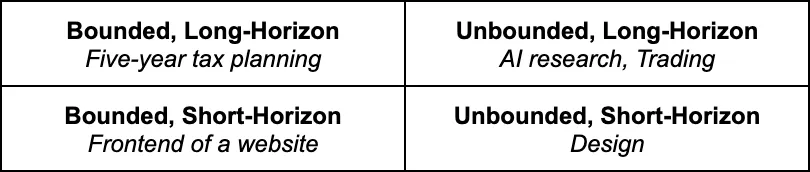
When you face a bounded task, especially a repeatable one like writing the same transcript over and over, you optimize for cost and speed. The work converges on the cheapest capable model, and here small open-weight models a step behind the frontier can win on price.
But where the marginal value of additional intelligence remains high, the frontier keeps its pricing power. Imagine competing in quant trading against Jane Street, allegedly a major Anthropic customer, with a materially weaker model. You are toast.
According to Cattani, this creates a reflexive spiral: tokens generate more revenue at the frontier, and the revenue buys more tokens and compute to expand the advantage, driving more tokens sold. He estimates such loops drive roughly half of frontier lab revenue and much of the capex buildout. He warns the loop can run in reverse, though I agree with him that doesn't look likely anytime soon, because capex on frontier models keeps delivering capabilities the market pays for.
Place Europe on this map. Our adoption is allegedly "world-class": 20% of EU enterprises used AI in 2025, Denmark leading at 42%. But according to Eurostat, our number-one workload is text mining: documents, summaries, extraction, and other relatively bounded tasks, mostly done inside $20/month subscriptions. By this model, almost all of that will increasingly run on commodity models where it can be consumed easily.
Meanwhile Europe holds roughly 5% of global high-end AI compute against America's roughly 75%, and much of the compounding, strategically decisive work still runs on the other side of the Atlantic.
That's why (almost) nobody asked for sovereign AI in Europe. There was nothing at the frontier to ask for in Europe. We were selling sovereignty bundled with a capability downgrade.
Here's what's changing, and why I'd take the other side of the Chief AI Officer's observation as a forecast: The frontier is no longer just a model. It's a system.
For years, delivered intelligence and raw model quality were almost the same thing. Whoever pre-trained the biggest model shipped the smartest product, and pre-training is increasingly a capital monopoly.
But capability gains now come from somewhere else too.
Test time compute: the same weights think longer on hard problems and produce materially better answers, so capability is now partly bought per task rather than baked in at training. Harness engineering: Claude Code is a harness, not a model, and it has become one of Anthropic's fastest-growing businesses. Agentic engineering: decomposing work, routing steps, tool use, state management, governance. The same model can complete a task inside a well-built loop or fumble around naked without it. Inference optimization: costs are collapsing quickly, which converts directly into more thinking per euro. Post-processing: validators, retrieval, structured outputs, PHI scrubbing, domain-specific checks. The unglamorous layer that turns an impressive demo into something a regulated enterprise can actually depend on. We live this daily at Corti: in specialized domains, a well-harnessed open model can beat a generic frontier.
Put these together and the strategic picture changes. The gap between open weights plus scaffolding and closed models has narrowed dramatically across a growing share of commercially relevant unbounded workloads, and more of what closes the remaining gap comes from harnesses, orchestration, verification, inference-time compute, and domain engineering, and less from raw compute alone.
For the first time, running near-frontier intelligence on European soil, under European law, does not require a major capability sacrifice, and the share of "frontier" capability that lives above the weights grows every quarter.
We believe that the moment sovereignty stops coming at the cost of intelligence, the demand lying dormant inside "compliance requirements," "price predictability," "data residency," and "vendor risk" gets translated into euros.
We rebuilt our own stack on that thesis and opened it as Corti Models: near-frontier open weights, harnessed, orchestrated, and served on European infrastructure. The results across our workloads: 2.5x the speed of the frontier APIs we replaced, quality on par with them in our domains, and materially lower build costs, because a system tuned to the task doesn't waste thinking (nor do we force you never to KV cache anything ;).
That's the systems dividend, collected in production, under European law. Companies will ask for the best AI they're allowed to depend on. When that offering is frontier-near, the European AI workload really kicks off, and that is the actual opportunity.
Sovereign AI wins when sovereignty stops being the product and becomes a property of the best infrastructure.