
TL;DR
- Clinical documentation has grown from roughly 1,700 words per patient at admission in 2006 to nearly 60,000 words by 2022, but EHR search tools have not kept up, leaving clinicians to piece together timelines manually.
- The problem is not missing data. In most cases, the information exists; it is scattered across systems, notes, and institutions, with no structure to surface the chronology.
- Timeline gaps affect every care setting: ED triage, ICU handover, shift transitions, and pre-procedure checks, often multiple times per shift.
- The solution is an intelligence layer that retrieves and orders what is already there, with honest handling of conflicting accounts and explicit gaps.
Every clinician has done this. A patient arrives. You open the EHR and start scrolling, reading note after note, building a mental picture of what happened, when, and in what order. That picture, assembled in your head from thousands of words of documentation, drives the decisions you make in the next hour.
This is one of the most consequential workflows in medicine. It is almost entirely manual.
Corti's Clinical Innovation Team runs regular deep dives into workflows that appear functional on the surface but carry significant hidden cost. This post covers our most recent session, focused on what we are calling the clinical timeline problem.
The core issue
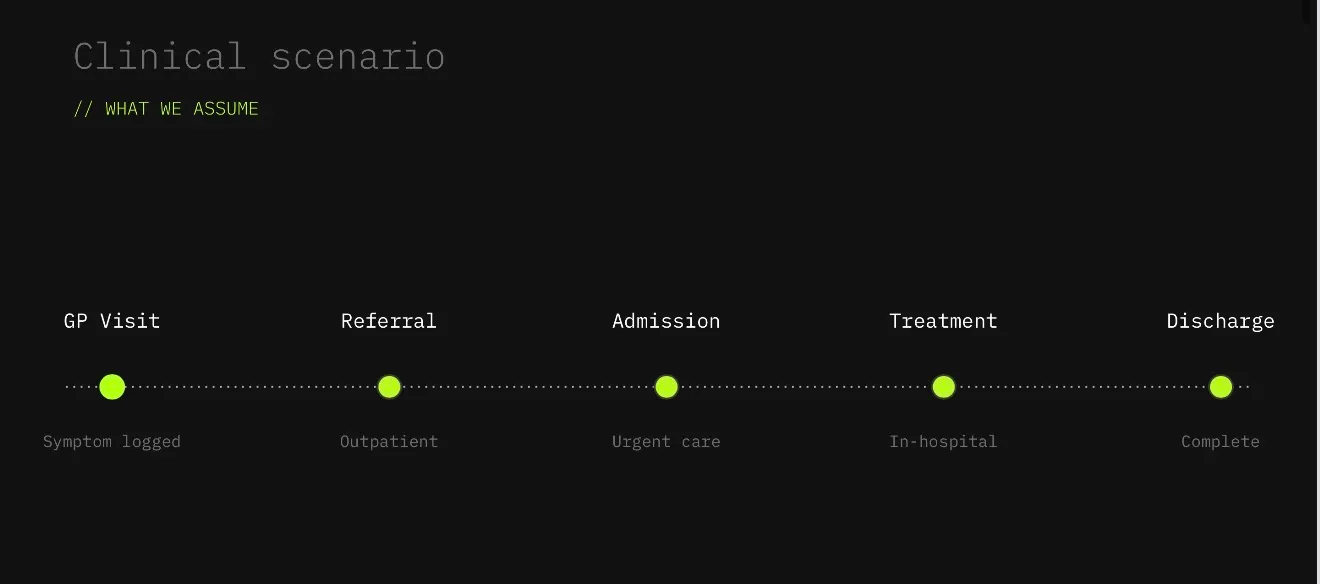
The textbook version of a patient journey is linear. A patient sees a GP, gets a referral, is admitted, treated, and discharged. The documentation follows that arc.
The real version looks different. A patient has a symptom. They see a GP, get sent home with medication, improve, and forget about it. Years later the symptoms return. They see a different GP, get referred to a specialist, maybe a second. They are admitted to one hospital, transferred to another. Each encounter produces documentation, in separate systems, under different formats, with no shared structure connecting them.
By the time a clinician needs to understand that patient's full trajectory, there is no single view. There is a stack of documents across institutions, written in different styles, with the chronology buried in prose.
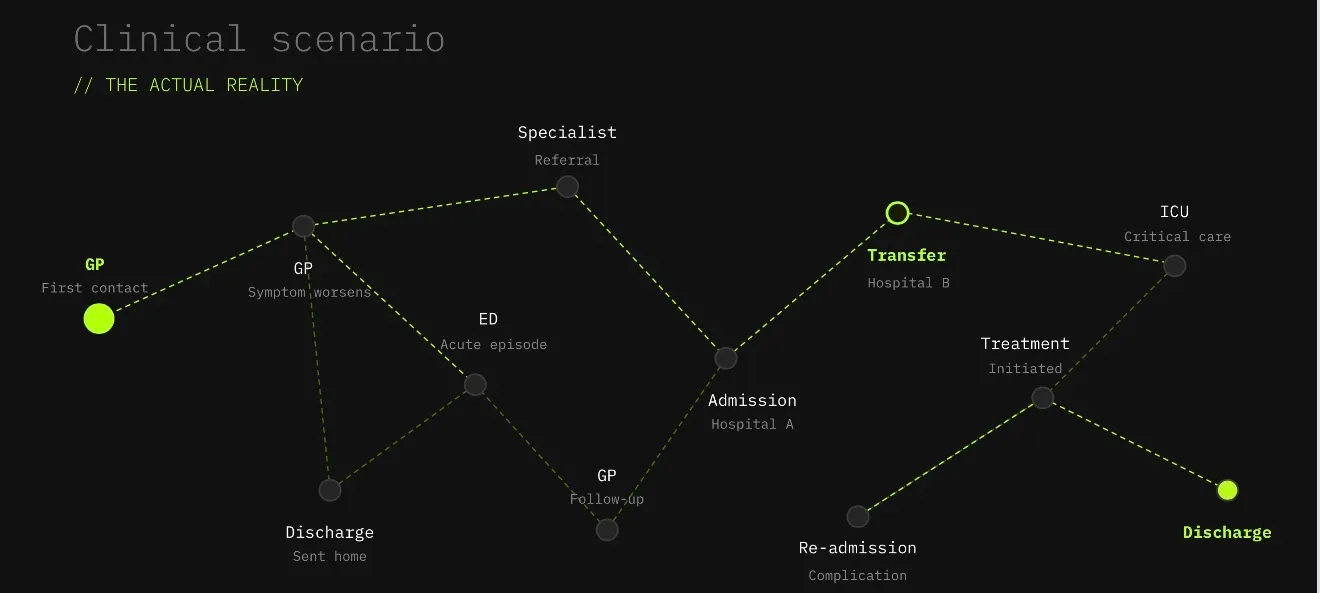
The problem is not that the data does not exist. In most cases, it does. The problem is that no one has ever assembled it into a coherent timeline, and the systems clinicians use every day were not built to do that automatically.
Three layers of the same problem
The timeline problem shows up at three different scales.
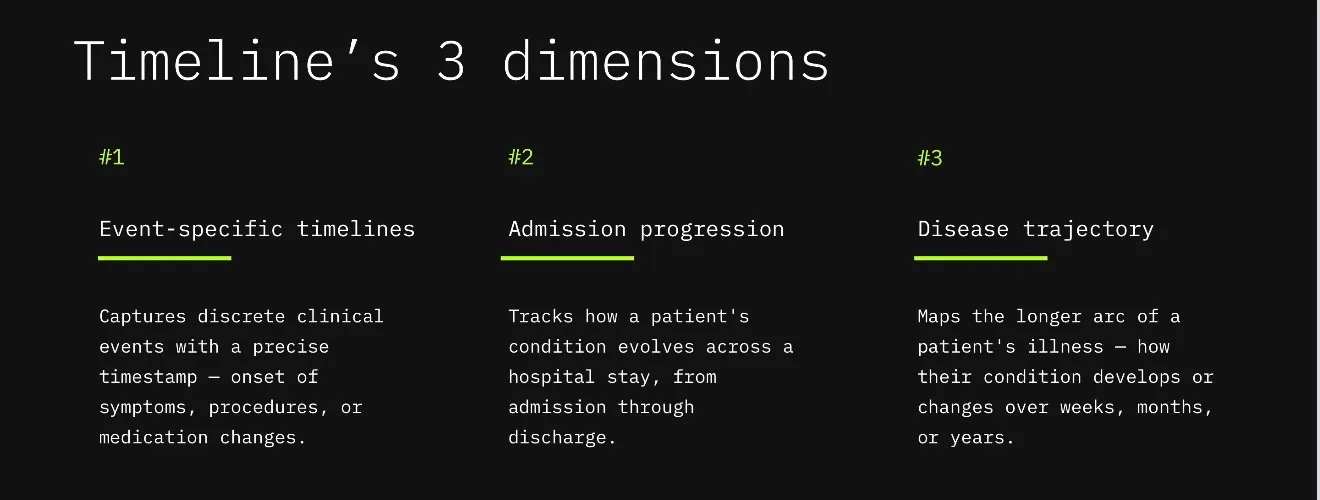
Event-level timelines. During a five-hour surgery, over a thousand data points are generated: medications administered, instruments used, vitals tracked, observations noted by the surgeon, the anesthesiologist, and the nursing team. When a question arises about what happened during that procedure, there is no structured sequence to refer to.
Admission progression. When a clinician starts a shift or returns from leave, the question is simple: how is this patient doing, and what has changed? The answer is not simple to find. It requires reading through every note from the previous shift, or the previous several days, and constructing the arc mentally. In an ICU, where documentation volume is at its highest, this can consume a significant portion of a shift just to get up to speed. An ICU physician we spoke with described returning from leave to find no single view of what had happened to his patients across hundreds of individual entries.
Disease trajectory. Zoomed out further, the problem spans years. A rare disease in Europe takes an average of 5.7 years from symptom onset to diagnosis. Each specialist encounter is documented in isolation. Referral loops repeat. Tests are ordered again because previous results are not accessible. The same patient history gets re-elicited, re-documented, and re-evaluated by each new clinician who touches the case.
What clinicians are actually working with
A 2023 study tracked the total word count of clinical documentation available at the point of admission. In 2006, the median was roughly 1,700 words. By 2022, it had grown to nearly 60,000. That is the documentation that already exists before the current admission begins.
The EHR search functions that are supposed to help navigate this do not work well in practice. Looking up a medication means scrolling through days of timestamped entries one by one. Keyword search returns long lists of loosely matched notes, unordered, without context, often making it easier to just scroll the record manually.
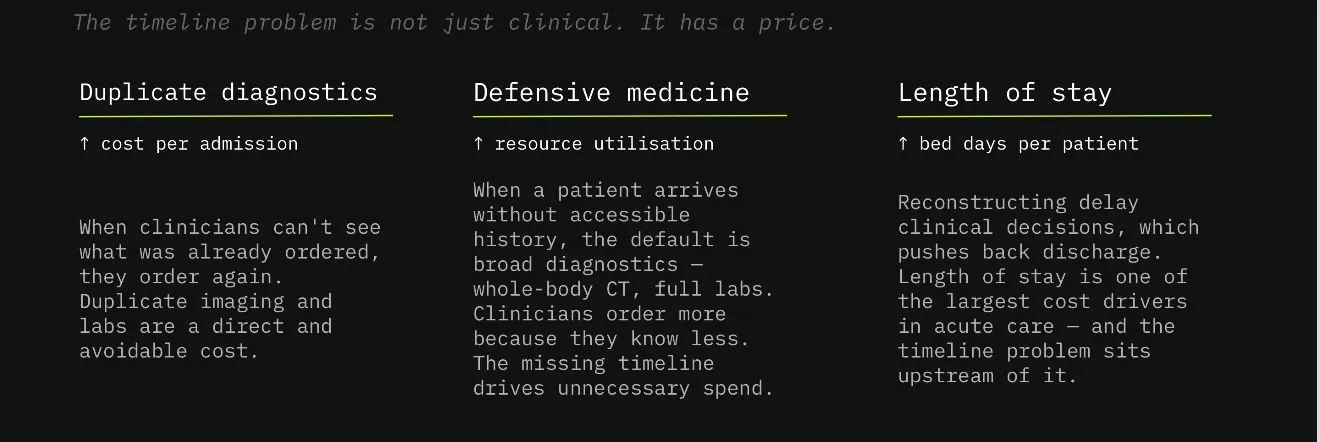
The result is that clinicians have developed a workaround: read enough to build a rough mental model, rely on colleagues for handover context, and proceed. It works most of the time. When it does not, the consequences can be serious.
When the workflow fails
Consider a scenario that is not rare.
It is 11 PM in an emergency department. A patient arrives with lower back pain she mentioned to her GP three weeks ago. She now has numbness in her inner thighs and difficulty urinating. These are warning signs of cauda equina syndrome, in which a disc herniation compresses nerves in the lower spine. If that is the diagnosis, surgery needs to happen within 24 hours. After that window, the neurological damage may be permanent.
To assess urgency, the clinician needs to know precisely when the numbness started and how it progressed. That information is likely in the record somewhere, across notes from the GP and possibly a prior hospital visit. Finding it takes time. Time that directly affects the outcome.
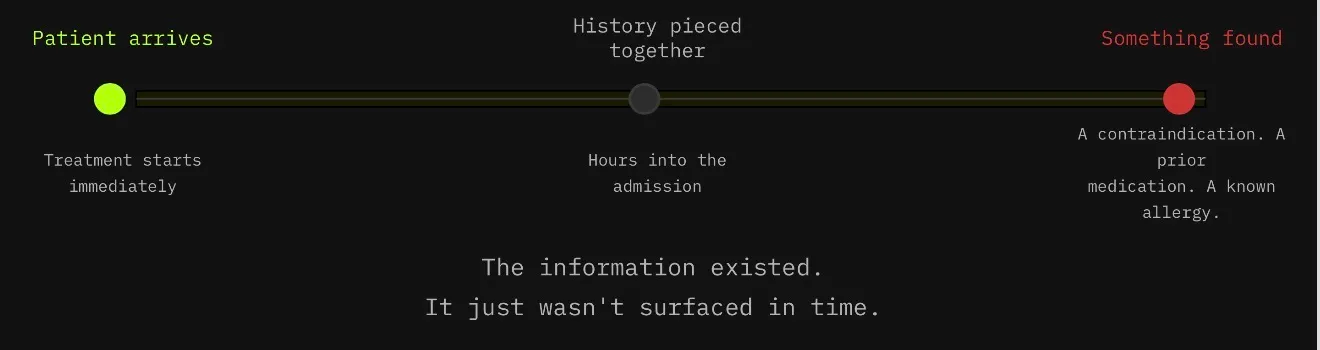
An ICU physician described the pattern directly: in critical care, the sequence often runs "first we treat, then we find out." The team does not have time to review documentation before starting treatment on a critical patient. The review happens later, and sometimes what surfaces is a contraindication, an allergy, a prior medication that changes the picture entirely.
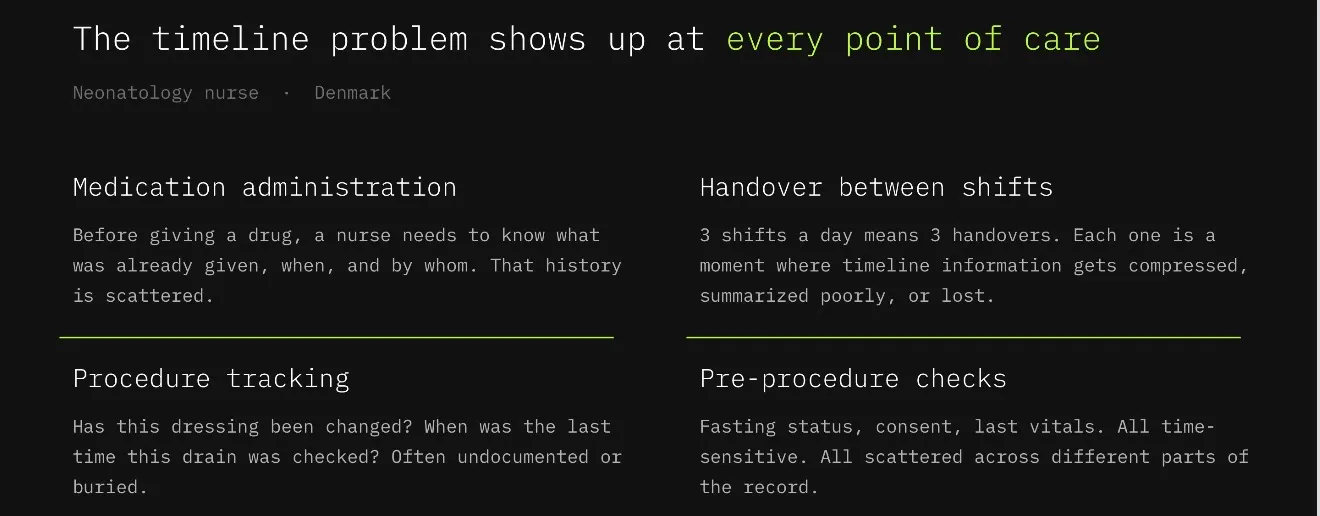
A neonatology nurse gave us a more routine example: before a procedure, fasting status, consent, and last vitals are all time-sensitive but scattered across different parts of the record. There is no single view that flags what is missing or out of date. This is not a crisis scenario. It is a gap that occurs multiple times per shift, across every handover, every new admission, every moment a clinician needs to make a decision on incomplete history.
The data is there. The view is not.
This is the central finding from the deep dive, and it matters for how you think about the solution.
In most cases, the information clinicians need exists in the record. It was documented. It is not missing. It is scattered across notes written at different times by different people in different systems, with no structure surfacing the chronology.
Some history is genuinely absent, things the patient does not remember, records from institutions whose systems do not connect, or events that were never formally documented. But that is a smaller portion of the problem than it might appear. The dominant failure mode is not missing data. It is inaccessible data.
That distinction matters because it points toward the type of solution that can actually move the needle: better retrieval and presentation of what is already there, not just better capture going forward.
Where this points
The clinical timeline problem is, at its core, a problem of extracting meaning from large volumes of unstructured text, ordering it chronologically, and presenting it in a way that is useful at the moment of care.
A few things any solution would need to handle: conflicting accounts across encounters, where patients report the same events differently at different times; role and context sensitivity, where an anesthesiologist and a shift nurse need different views of the same record; and honest gaps, where the system makes it explicit that history is missing rather than implying nothing happened.
The starting point that emerged from the discussion is a single, chronological view of a patient's documented events: what happened, in what order, with what was known at the time. That view has direct value on its own. It also forms the foundation for everything more sophisticated: role-based filtering, query interfaces, proactive alerts.
The timeline problem is solvable. The data exists. The gap is between clinical insight about what matters and the capability to surface it reliably.
Corti's Clinical Innovation Team runs regular problem exploration sessions across clinical workflows where AI can make a meaningful difference.
Build faster. Ship safer. Scale smarter.
Get started with healthcare-native APIs built to power real clinical workflows.