
Symphony for Medical Coding
The only AI medical coding API that codes like a human
Integrate the world’s most accurate AI medical coding API in hours. One call returns structured ICD-10 and CPT predictions, supporting evidence, and a complete audit trail.
The problem
Bad medical coding costs billions.
The tools haven’t caught up. The result is overcoding, missing audit trails, and a retraining obligation you did not sign up for.

Generic LLMs don’t reason codes
Every code in the note comes back. No selectivity, no audit trail, no chain of custody your compliance team can stand behind.

ML pipelines break every October
Coding updates require retraining. Every cycle creates an accuracy gap, and you own the maintenance problem.

RCM services don’t scale
Sold with implementation projects, not API access. Integration means a vendor contract, not a function call.
How it works
An AI coding engine that reasons like a trained coder
Reasons over clinical data to determine which conditions should be coded and why, then traverses the coding hierarchy to find the most specific correct code. Every prediction returns source evidence, ranked alternatives, and a justification grounded in coding rules.
Benchmarks
Ranked #1 on automated medical coding benchmarks
Highest performance across synthetic, academic, and real-world clinical data.
Accuracy Comparison
74%
F1 accuracy. Outperforming Anthropic (59%), Amazon (58%), OpenAI (48%), and Google (43%).
>25%
Improvement vs. the next-best system. Beating competitors on both precision and accuracy metrics.
#1
On noisy clinical datasets. Maintaining lead in real clinical environments, outperforming OpenAI and Google.
Production-ready
Global coverage across the world’s major coding systems
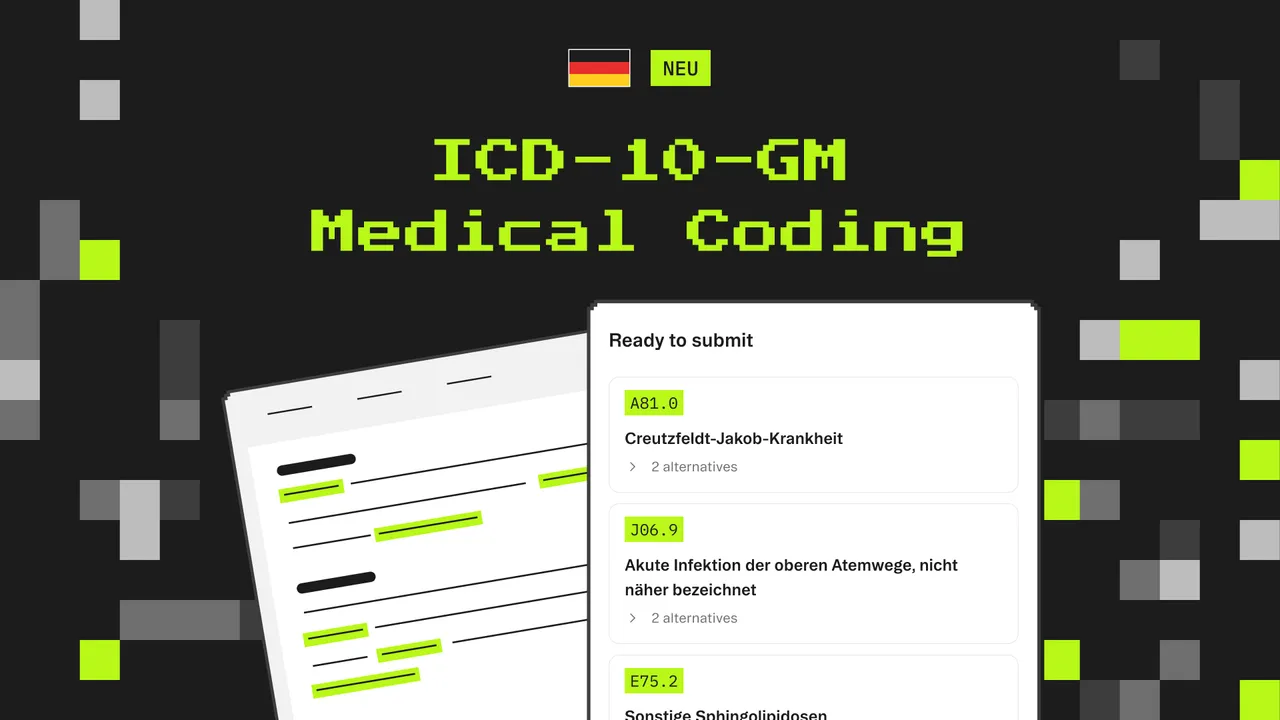
Available today across ICD-10-CM, ICD-10-PCS, CPT, ICD-10-UK, and ICD-10-International.

Hear it from them
What developers are saying

“The methodology behind Code Like Humans™ is the most promising approach to medical coding we’ve seen.”

“Higher-quality coding strengthens the performance of our AI-driven rules engine and billing agents - resulting in more reliable billing, better compliance, and more efficient financial administration.”
Built for the complexity of medical coding

Accurate. Ranked #1 on automated medical coding benchmarks. Reasons over full clinical notes - not pattern-matching against text.

Auditable. Every code traces to the source. Every exclusion is explained. Returns evidence excerpts and rule justifications your compliance team can stand behind.

Evergreen. When coding systems updates ship each year, Symphony automatically updates with them. No retraining cycle. No maintenance on your side.

Global. One API. ICD-10-CM, ICD-10-UK, ICD-10-PCS, CPT, and more. No data localisation requirements or geography-dependent coverage gaps.

API-native. A single POST request returns structured, ranked codes with evidence. No implementation project. Integrate in hours.
Compare
How Symphony for Medical Coding stacks up
| Feature | Symphony | Generic LLM |
|---|---|---|
| Coding reasoning engine | YesNative | No |
| Audit trail per code | YesBuilt-in | No |
| API-native integration | YesYes | Yes |
| Developer-side retraining | YesNot required | Complex |
| Code system coverage | YesGlobal | Limited |
| Time to integrate | YesFast | Long & expensive |
Build option: Agents
Explore Agents and build with medical coding Connectors
Pre-configured Agents and Connectors you can customize and deploy.
Medical Coding Agent
Generate accurate medical codes from clinical context

Prior Authorization Agent
Generate evidence-based prior authorization letters

Clinical Documentation Improvement (CDI) Agent
Review clinical documentation for accuracy gaps

Referral Generator Agent
Generate clinician-to-clinician referral letters

Denial Appeals Agent
Appeal denials with evidence-backed responses

Note Completeness Agent
Ensure clinical note completeness in real-time

Surgical Registry Intelligence Agent
Automate surgical quality registry data entry

Diagnostic Entity Extractor Agent
Extract codeable diagnoses and assign codes directly

Procedure Entity Extractor Agent
Extract codeable procedures and assign codes directly

Code Validation Agent
Validate ICD-10-CM, ICD-10-PCS, and CPT code sets

Compliance Guardrail Agent
Validate code sets against payer or organizational rulesets

Rule Explainer Agent
Understand code selection reasoning

ICD-10 Index Navigator Agent
Go from clinical terms to candidate codes for coder review
Start building with Symphony for Medical Coding API
Full API access. No card required.
Symphony is ranked #1 on automated medical coding benchmarks. Unlike generic LLMs that return every possible code, Symphony reasons over clinical data to select only the codes that should be documented, with ranked alternatives and source evidence for each prediction.
Hours, not months. Symphony is API-native, so integration is a single function call. No implementation project, no vendor contract, no custom pipeline to maintain.
Coding logic is built into the engine, not trained into an ML model - so there’s no retraining required when coding guidelines change. Symphony stays current without the October accuracy gap that plagues traditional CAC tools.
Yes. Symphony is built for healthcare environments, including support for sovereign cloud deployments for organisations with strict data residency requirements.
Each call returns structured code predictions, the supporting clinical evidence, ranked alternatives, and a written justification grounded in coding rules - everything your compliance team needs for a complete audit trail.
General-purpose LLMs have no coding rules logic, no selectivity, and no audit trail. Symphony is purpose-built to reason through the coding hierarchy the way a trained coder would. With every decision traceable back to the source note.