
This October, Corti travelled across eight European cities, joining developers, partners and industry leaders to explore what's needed to make that happen.
From sovereign AI and open-weight models to agentic systems, patient safety and connected care, the conversations tackled different challenges but pointed to a shared priority: making advanced AI accessible, reliable and controllable.
It's a challenge we've spent years solving in healthcare, one of the world's most demanding industries. Now, we're building on that experience to give developers the models, infrastructure and tools to bring frontier AI to other critical industries.
Here's what we shared, explored and learned on the road this October.
Sovereign AI without compromise
ai-Pulse | Paris, France | 13 October 2026
"If you don't have a plan for sovereign AI, you are putting your business at risk."
That was the message from Corti Co-founder and CTO Lars Maaløe at Scaleway's ai-Pulse in Paris.
But sovereignty isn't simply about where your data or models are hosted. It's about independence, controlling the technology your business depends on, from model performance and availability to pricing and deployment.
Lars explained how Corti combines powerful open-weight models, optimised inference and cloud-independent infrastructure, including Kommodity, to deliver frontier AI without locking businesses into a single provider.
Sovereignty shouldn't mean settling for less. It means having the freedom to build with frontier AI on your own terms without compromise.

Powerful AI, without changing how people work
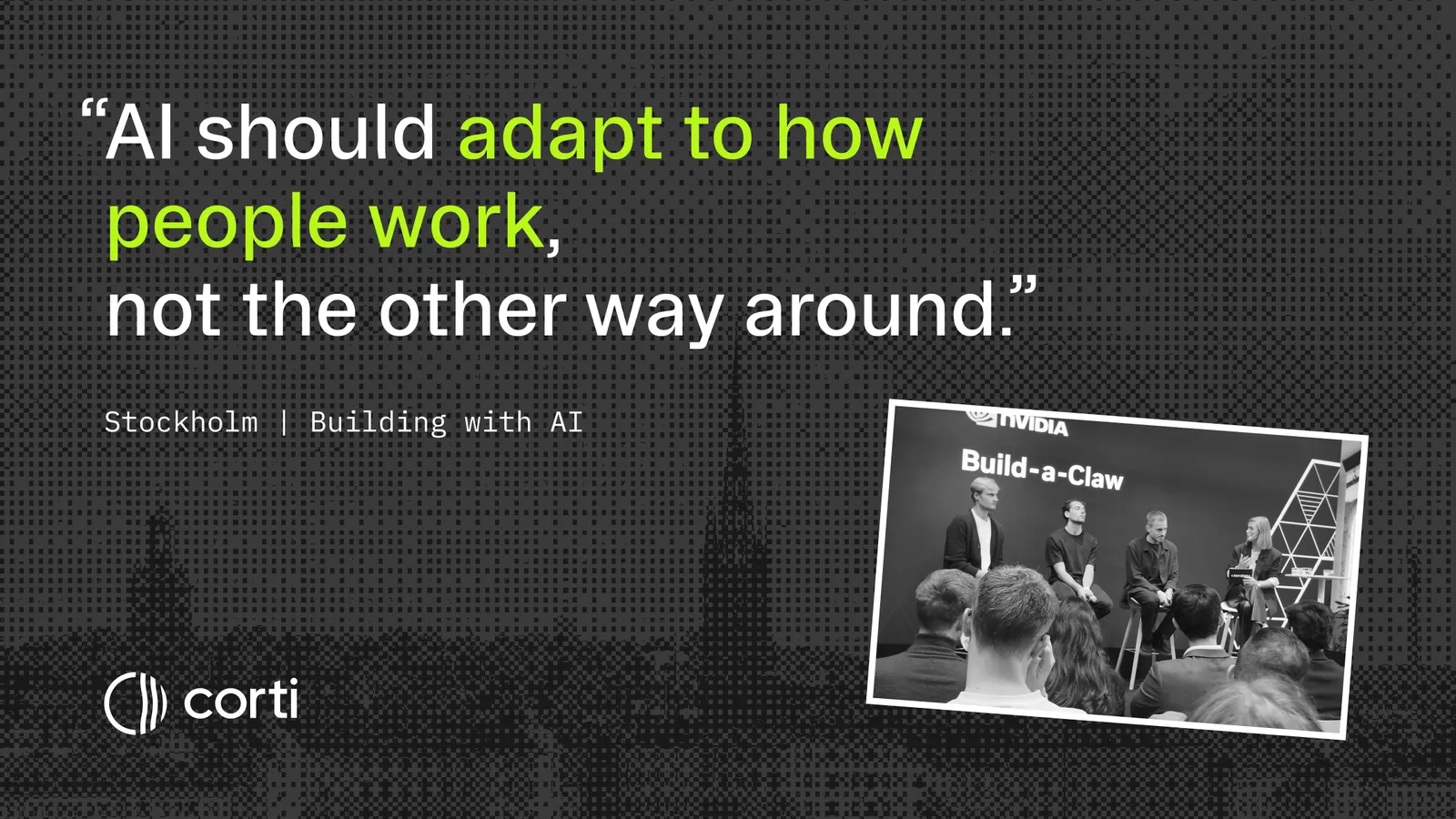
NVIDIA Build-a-Claw | Stockholm, Sweden | 20 October 2026
Why should adopting more powerful AI mean changing the way people already work?
Corti Co-founder and CTO Lars Maaløe explored this from two perspectives: developers building software and the people using it.
For developers, switching AI models shouldn't mean abandoning familiar tools. Lars demonstrated how Corti Bridge brings open-weight Corti Models into coding environments like Claude Code, giving developers greater choice and control. In an informal blind A/B test, developers who preferred Claude couldn't tell the difference when using Corti Models.
For end users, the principle is the same. Clinicians didn't enter medicine to navigate software. Lars highlighted how Dedalus is building approximately 30 specialised AI agents on Corti's Agentic Framework, enabling clinical tasks to be carried out within existing EHR workflows.
Whether building software or using it, AI should adapt to how people work, not the other way around.
Europe needs more than powerful models to compete in the agentic era
NVIDIA GTC | Berlin, Germany | 21 October 2026
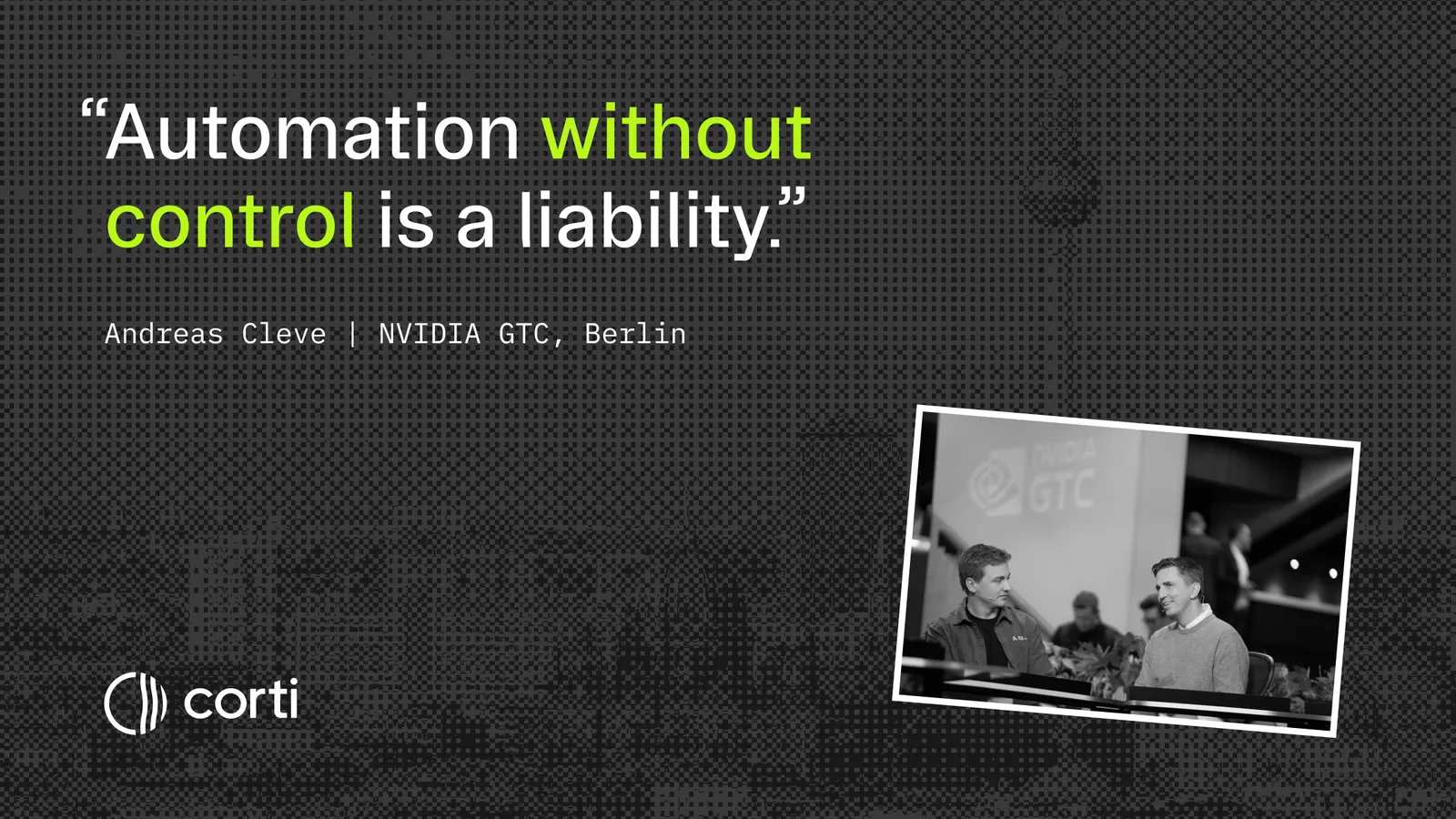
"Automation without control is a liability."
That was the warning from Corti Co-founder and CEO Andreas Cleve at NVIDIA GTC Berlin, where he joined AI founders, researchers and investors to discuss Europe's AI future.
As AI moves beyond answering questions to taking action, the stakes are rising, particularly in healthcare, where mistakes can have serious consequences.
Andreas argued that frontier intelligence is essential, but powerful models alone aren't enough. Making agentic AI work in the real world requires infrastructure that delivers speed, reliability and control, from optimised inference and low latency to multi-agent orchestration and built-in safeguards.
For Europe, the opportunity extends beyond healthcare. Andreas called for the ambition, infrastructure and talent needed to build globally competitive AI companies capable of turning frontier intelligence into real-world impact.
AI is bringing health and social care closer together
Care Show | Birmingham, UK | 7–8 October 2026
From ambient documentation to digital care records, AI is finding its way into everyday social care, with growing demand for technology that reduces paperwork and gives carers more time with the people they support.
At Care Show Birmingham, Corti joined more than 4,500 care professionals and technology providers, where conversations went beyond individual AI tools to a bigger challenge: connecting health and social care.
As the two sectors become increasingly interconnected, interoperability and shared information are becoming critical. The ambition for a Single Patient Record reflects a growing need for technology that works across services, rather than creating more disconnected systems.
The next opportunity for AI isn't just making individual care tasks easier. It's helping build a more connected, coordinated and person-centred care system.
Rethinking the healthcare experience
Bupa TechVision | Manchester, UK | 20 October 2026
What does healthcare look like when AI is integrated across the entire customer journey?
That was a central theme at Bupa's internal TechVision conference, where Corti's Sebastian and Ravi joined Bupa teams and technology partners to explore its vision for 2027 and beyond.
With AI, digital innovation and connected care central to Bupa's strategy, the focus was on improving customer experiences and delivering more personalised healthcare.
Our team also explored opportunities for collaboration across Bupa's wider business, including how AI infrastructure could connect patient information across systems, enable AI agents to coordinate tasks and embed capabilities such as clinical documentation directly into existing workflows, without adding more disconnected applications.
The opportunity is to make healthcare technology work together, giving care teams better access to information and patients a more seamless, personalised experience.
Clinical-grade AI, built for Swiss healthcare
IFAS | Zürich, Switzerland | 20–22 October 2026
Healthcare AI needs to understand more than medical terminology. It needs to work with local languages, clinical workflows and strict data protection requirements.
At IFAS in Zürich, Corti's Stefan Hohmann showcased how we're bringing specialised medical AI to Switzerland through our partnership with Voicepoint.
By integrating Corti's medical AI models into Voicepoint's Xenon® platform, Swiss healthcare professionals can access clinical-grade AI with enhanced support for Swiss German and Swiss French, running on infrastructure operated locally by Voicepoint.
And the opportunity extends beyond one platform. Corti's models are also available to other Swiss healthcare software developers looking to build AI into their own applications.
Bringing frontier AI into healthcare means combining clinical performance with local language support, data privacy and the flexibility to build on existing systems.
Building the next frontier of AI in Denmark
Danish Data Science Community General Assembly | Copenhagen, Denmark | 30 October 2026
What does it take to build frontier AI that developers can actually control?
Corti's Simon Kruse and Paul Thuriot joined the Danish Data Science Community to explore why the system matters as much as the model, from optimising and deploying open-weight LLMs to building agentic software.
The discussion came as Corti announced plans to train and post-train trillion-parameter models in Copenhagen, marking another step in its frontier AI ambitions.
Beyond the technology, the event highlighted the importance of Denmark's open-source AI community, where access to compute, shared research and local expertise are helping developers push the boundaries of what's possible.
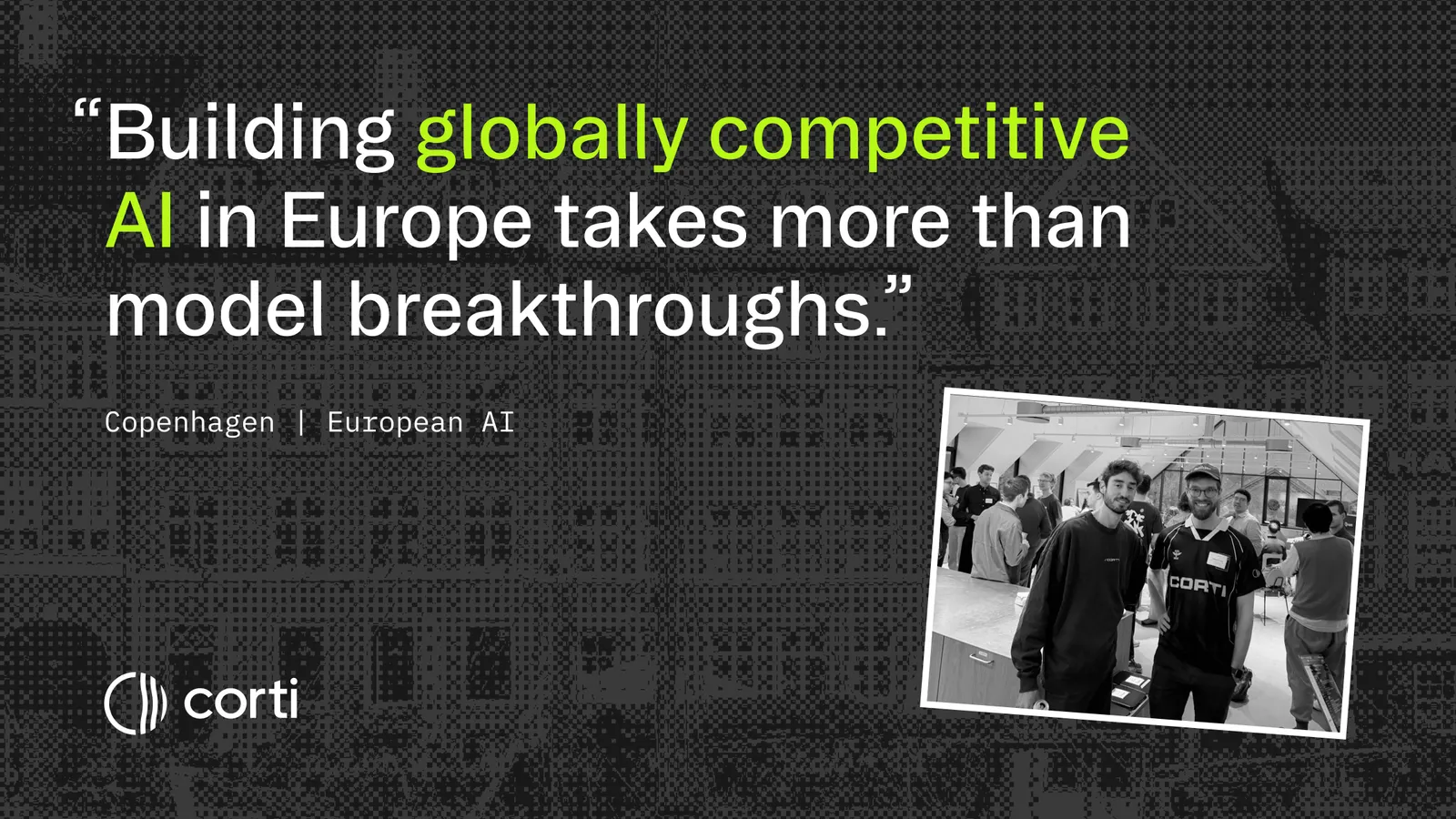
Building globally competitive AI in Europe takes more than model breakthroughs. It takes the infrastructure, talent and community to turn them into reality.